Someone Called a Cab?

Someone Called a Cab?

Being carless in Jersey City wasn’t that big of a deal most of the time. The entire time I was there, I either lived on a well-trafficked street which the buses and jitneys traversed (Palisade Avenue) or just a block away from a major street (Kennedy Boulevard).

I think back and laugh out loud, now, at the memory of our first night in Jersey City. I moved in July 1992, and Tony drove out with me from Phoenix, staying one night before he turned around and flew back. (He moved out to Jersey about a year later.) Rather than stay with my sister that night, we got a motel. We hadn’t yet moved up to hotels – and knowing nothing about the area, we went where we saw the signs, to Tonnelle Avenue. Imagine Tony’s surprise when he went in to get a room at one of these local establishments and the clerk asked, in response, “You want it for the whole night?” Yeah, we were in red-light district, flophouse squalor.

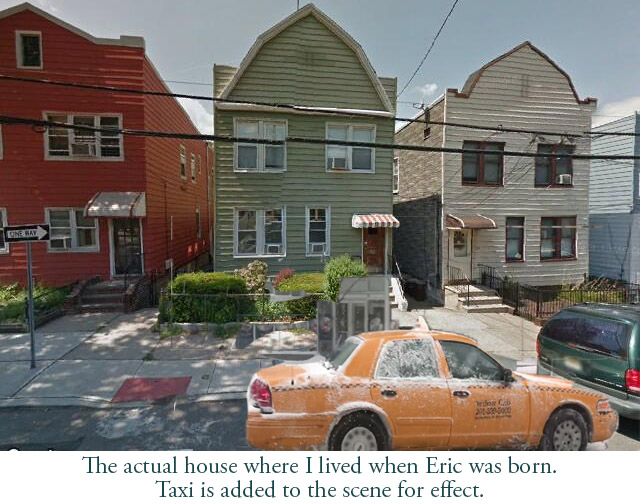
Interestingly enough, a couple years later, when I moved out of the apartment I’d shared with Tony and Mike, I wound up just two blocks away – up the literal hill – from those same by-the-hour joints. My street, Liberty Avenue, was right in between Tonnelle and Kennedy. That was where I was living when Eric was born; the whole timeline seemed like coming full circle.

So we could usually catch public transportation either at our front door, or just a block away. Unless it was super cold, snowing, sleeting, or the middle of the night. Those times, you had to call a cab – Uber was not even a gleam in Travis Kalanick and Garrett Camp’s eyes. And sometimes the cab actually showed up. To be safe, like in the event you really needed to get somewhere on time, you usually called two different cab companies – slightly increasing your odds of one of them actually arriving to get you to your destination.

These were the things I was thinking about on the cold, snowy, sleety February days before the baby came. How would we get to the hospital? If we had to take a cab, would it actually arrive within the hour after we called it?

Eric was due on Monday, February 20. The day came … and went. No contractions. Just the feeling of my belly being swollen beyond where its skin could stretch – and having to sleep in a reclining position, as there was no other way to be comfortable. At my checkup that week, the doctor decided that if the baby didn’t come on his own, we’d induce the morning of Friday, February 24.

I’ve often wondered if there are any statistics about babies whose moms have made adoption plans being overdue. Would make sense that the mom wants to hang onto that kid for as long as possible – even if it’s just one extra day or two. And, perhaps, the kid wants to hang onto her, too. As it turned out, my son didn’t want anyone to tell him when he would make his entry. I went into labor that Thursday evening, so there was no need to induce.

You know how in every single movie or TV show they make such a big deal about the pregnant woman’s water breaking? I do not remember my water breaking. I’m sure it did – but there was no dramatic puddle on the floor. The contractions just began, became more insistent, and got closer together – so we called the doctor’s service and they said it was time to get to the hospital. The transportation gods were with us that night, the cab showing up within 10 minutes of our calling it.

Labor was longish – 13 or 14 hours, if I remember correctly. Again, Kathy probably has all of this much better recorded than I do. I mentioned in a previous post that the epidural didn’t really work, more than likely because of my scoliosis. So the labor was painful – plenty painful – I shrieked and wailed between every push, the nurses doing their best to calm me down to conserve my energy. But then he came – and he was beautiful. Tony was in the room – and he was a champ. He stayed with me, tended to me, made sure we were both OK.

I’d been in the room when my niece was born, three-and-a-half years earlier. Samantha was just hours old, my sister still in immense pain and slow moving when she needed to get up to go to the bathroom. Her husband was there, and she asked him to help her. He took his time getting out of his chair, and then on his way to the bed dropped the coins he was holding in his hand on the floor. As I write this, it occurs to me for the first time that he might actually have dropped them on purpose. So he stopped, picked up them up one at a time, and eventually made his way to Corina’s side – by which time she’d pretty much gotten to the toilet on her own. As much of a dick as Tony was at times, he never behaved that way in the hospital.

Some birthmoms choose to have one of the adoptive parents in the delivery room. It feels a bit selfish now, but I couldn’t do that. We needed something that was just ours, so we asked Kathy and Bruce to wait to come to the hospital until we called them. They arrived maybe four hours after Eric was born. The sight of Kathy picking him up and so expertly holding him warmed my heart and crushed me at the same time. That was the reason I’d chosen these people, this couple, to be his parents. They’d already been through it – they were good at parenting and I trusted them not to make the mistakes new parents would make. It would be a new experience for them, though, because this was a boy. They’d had girls first, so there would still be a learning curve. But the feeding and washing and tending and caregiving would be the same – and I knew they’d do a fine job.

____________________
Laura Orsini is an author, speaker, and consultant who coaches other authors to make and market exceptional books that change the world for the better. She is birthmother to Eric, who is finishing college in Boston this summer. Their adoption has been open for the better part of Eric’s life. She continues to toy with the idea that these posts will one day become a book. In the meantime, you can learn about her novel in progress, Stan Finds Himself on the Other Side of the World.

Things I Wish Someone Had Told Me Beforehand

Things I Wish Someone Had Told Me Beforehand

As far as I’m aware, there’s no rule that a pregnant woman considering adoption must have counseling, although it is highly encouraged. I remember hearing once – again, research to support this piece of anecdotal information yielded nothing – that by law, counseling had to be offered to a woman considering adoption, even a private attorney adoption, but that’s pretty much the extent of things. As you might imagine – particularly if you’ve ever dealt with (or been) a pregnant woman – she has lots of bonus hormones looking for a place to land. Combine that with an ill-timed, out-of-wedlock, and/or crisis pregnancy and a woman considering adoption, and you’ve created the emotional perfect storm.

It’s not the time for remembering details – or hearing, let alone acting on, the information. Particularly when someone says, perhaps as a casual comment, “Oh, by the way, counseling is available if you want it.” That’s why an agency adoption is so important for the prospective birthmother. She is assigned a caseworker who makes sure to talk her through the most essential details – and offers an ear to listen, as well as (hopefully) wise counsel and answers to any questions the pregnant mom does think to ask in her flustered state. That’s the problem, though, with a first-time pregnancy. You don’t know what you don’t know.

On the other hand, I don’t envy the job of an adoption social worker – or any social worker, for that matter. At least a baby usually finds a (better) home at the end of an adoption, so I guess there are pluses. But I imagine there’s a lot to know and remember to explain along the way. Still, it would seem there should be a checklist of topics for the caseworker to discuss with the pregnant mother, whether or not she decides to keep the baby. If she’s going to carry the pregnancy to term, things will come up and decisions will need to be made.

Yes, there’s that ubiquitous book, What to Expect When You’ve Got Anything at All to Do With Having a Kid, EXCEPT Be a Birthmother. That book – and all the others like it – focus on the happy event, assuming the baby will go home from the hospital with the same people it went in with, which is exactly what does not happen in adoption. Not ideal reading for the prospective birthmom. As I’ve mentioned in the past, Patricia Roles’ book, Saying Goodbye to a Baby, came closest to answering and addressing my questions, but (a) I didn’t find it until after my son was born and living with his other family and (b) even it didn’t cover some of the more basic issues.

As a matter of fact, after scoping out the Amazon reviews for Roles’ book (two 5-star reviews; two 2-star reviews, and one 1-star review), I think I’m going to order another copy so I can re-read it, 22 years later, as it seems my perspective just may have shifted. I do get the sense that the writer of the 1-star review is one of those people I wrote about in a prior post who has no desire to release her grief or heal from the adoption wounds. Yes, her pain is real, and there is no timeline for getting over it. But forward movement after any trauma is probably a healthier option than choosing to live in that pain forever. Yes – for many people, birthmothers included, living in pain is a choice.

So here are the things I wish I’d known before they occurred:

My scoliosis would matter when it came to the epidural. Epidural is a drug commonly used during labor and delivery. It is inserted into the spine by an anesthesiologist, with the command, “Hold still or you might wind up paralyzed.” I had a single dose that helped for the first little while, but the second dose didn’t “take.” We later deduced that the curve in my spine meant the epidural hadn’t gone where it was supposed to go. The nurses told me the pain I experienced was the equivalent of natural childbirth. You’re welcome, kiddo!

Those little red dots all over your neck and chest are capillaries that broke during the “pushing.” Nothing earth-shattering here, but it would have been a good thing to know so I didn’t have to freak out about it.

The birthparents make the circumcision decision. It was a bit surprising to find out after the fact that my OB/GYN did not perform this procedure. So Eric had to go home a happy kid, and come back a week later to be mauled and – some might say – mangled. Although a huge debate churns on about the merits of circumcision, as I understand things, the child still generally does whatever the father did. Had I realized ahead of time that it would be important to know my doctor’s stance, I would have made other preparations.

Breasts are milk producers. Duh, right? But not when you’re not expecting it. No one prepared me for my milk to come in, or informed me of the need for nursing pads even though I wouldn’t be nursing. Not to mention that nursing the baby you will place for adoption is an option. It would seem immeasurably more difficult to surrender a baby with whom you’ve shared that kind of bond, but I have known birthmothers who’ve done it.

I could have had Eric baptized in the hospital and been there for the ceremony. This is, of course, specific to Christian religious belief – in our case, Catholic. It wasn’t until I read in a chatroom about a birthmom who did this that I was even aware it could have been a possibility. Again, this is less important to me now, but it would have been a very special moment to share and is one of my very few regrets.

Grief can show up as anger. Though I discussed this in a prior post, it’s worth noting again here. I spent the entire first year of Eric’s life extremely pissed off at the world, and it wasn’t until someone I didn’t even like very much pointed it out to me that I recognized that anger as grief. I’m not sure there would have been anything to do differently, but it feels like it would have been useful information at the time.

It seems unlikely that Patricia Roles will update her book – so maybe it is time for a new book. And maybe my job is to write two of them: one, a handbook like Roles’ for birthparents, and the other my own adoption story.

____________________
Laura Orsini is an author, speaker, and consultant who coaches other authors to make and market exceptional books that change the world for the better. She is birthmother to Eric, who is finishing college in Boston this summer. Their adoption has been open for the better part of Eric’s life. She continues to toy with the idea that these posts will one day become a book. In the meantime, you can learn about her novel in progress, Stan Finds Himself on the Other Side of the World.